Open offices have become the mainstream design of the modern workplace, breaking down physical barriers and promoting collaboration and the flow of information. However, as this layout has become more widespread, a long-overlooked problem is gradually surfacing: the lack of noise control and privacy is quietly eroding employee productivity and well-being.
To objectively assess this issue, we reviewed multiple international studies in an attempt to reconstruct the true acoustic cost of open offices and to explore the value of soundproof pods as a practical solution.
I. What Is Noise Stealing? Four Sets of Data Reveal the Truth
30 minutes a day, vanishing into thin air. According to research by the JNA Association, an active employee loses an average of 30 minutes of effective working time per day due to noise distractions. Based on 250 working days a year, this equates to about 125 hours lost per person per year—more than 15 full working days. For a team of 60 people, this means nearly 9,000 hours of collective productivity loss each year.
Productivity drops by 66%. Sound expert Julian Treasure pointed out in The Sound Agency that in open-plan offices, employee productivity is 66% lower than when working independently. This figure is shocking, yet it aligns closely with the real-life experience of many office workers: when surrounded by phone calls, discussions, and keyboard clatter, deep thinking becomes almost a luxury.
23 minutes to “snap back.” Research by Professor Gloria Mark at the University of California, Irvine, found that after an interruption, employees need an average of 23 minutes and 15 seconds to return to their original task. This means that a seemingly brief distraction costs far more than those few seconds—it shreds the entire rhythm of work. In an open environment, such interruptions can occur dozens of times a day.
Short-term memory drops by 48%. A study in the Journal of Applied Psychology showed that compared with a quiet environment, employees exposed to high noise levels experienced a 48% decline in short-term memory recall. For roles that require processing complex information and multitasking, this impact is especially devastating.
II. Existing Solutions
In the face of these challenges, relevant solutions already exist. Installing acoustic panels, partitions, or cubicles is a common approach; they can indeed reduce noise levels to some extent and demarcate areas for focused work. However, these solutions often have limitations: acoustic panels cannot address the need for private calls; partitions and cubicles may undermine the flexibility of open collaboration and are difficult to adjust once installed.
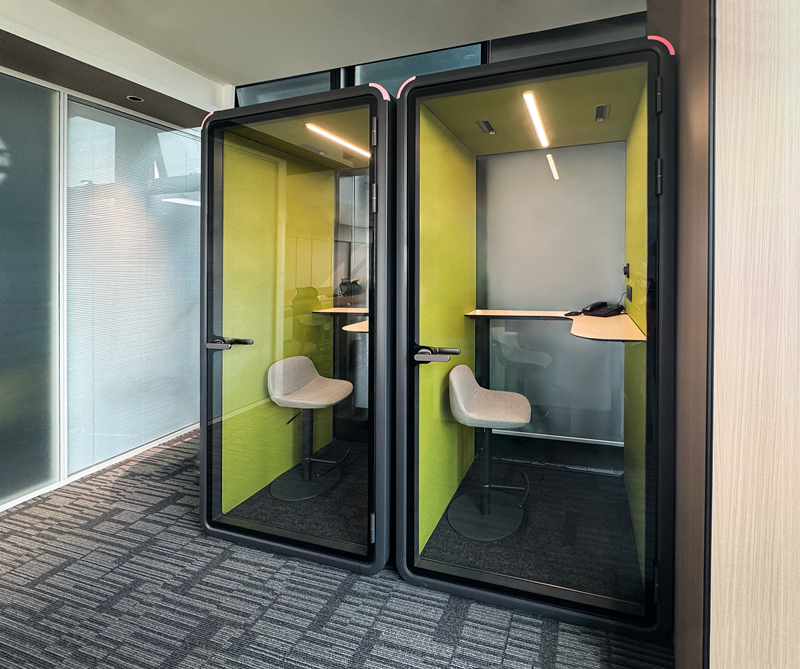
Another increasingly popular solution is the office pod. It provides employees with an enclosed, independent space for private conversations or focused tasks. These pods, designed specifically for office scenarios, are equipped with sound-absorbing materials inside and can create a quiet environment within a noisy office. Unlike fixed partitions, office pods usually feature modular designs that can be flexibly moved, quickly deployed, and do not disrupt the original open layout.
The advantages of open offices should not come at the expense of focus and privacy. The data clearly tells us that the cost of noise is real, quantifiable, and impossible to ignore. Office pods—especially products like HECOR, which feature modular design, intelligent ventilation, adjustable lighting, and third-party-verified sound insulation performance—offer companies a flexible, efficient, and sustainable complementary solution.
Interested?
Talk to us!
Contact our sales experts to know more about our product get a quote or book a visit. We are happy to help!
Contact Now !


