A Blind Spot Obscured by “Soundproofing Specs”
When choosing an office pod, almost all attention is focused on acoustic data: how many decibels of noise reduction, what STC rating it has, and whether there is a full-pod acoustic report. This is certainly important—but office pods have another, more hidden problem with more direct consequences: once the door is closed, is there still enough air inside?
Acoustic problems, at worst, make you “unable to hear clearly.” Air-quality problems, by contrast, can make your brain simply “stop working.” Multiple indoor-environment studies consistently point to the same threshold: when CO₂ concentration reaches 1,000 ppm, decision-making, problem-solving, and concentration begin to show measurable declines. In a sealed office pod without ventilation, an adult sitting quietly may see CO₂ rise from the outdoor level of about 400 ppm to around 900 ppm in just 5 minutes, exceed 1,500 ppm in 15 minutes, and rise above 3,000 ppm in 30 minutes. The subjective experience is the classic feeling of being stuffy, drowsy, and headachy.
Ventilation is therefore not an optional add-on for an office pod, but the dividing line that determines whether it can be used for extended periods.
Active Air-Exchange Ventilation: Making Airflow Itself Not Create New Noise
Air exchange requires a fan, and a fan produces noise. If an office pod with excellent soundproofing has a humming fan, the advantage of quietness is canceled out by internal noise.
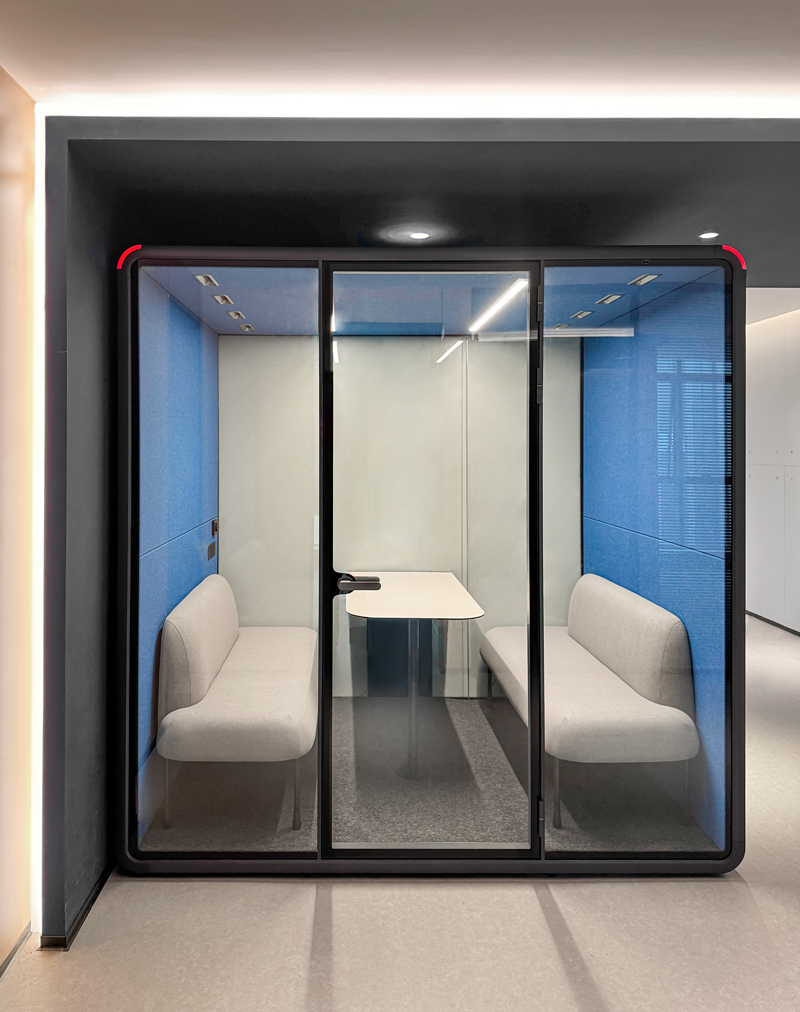
HECOR’s solution is a centrifugal fan. Unlike ordinary fans, a centrifugal fan uses a fixed drum-shaped housing with a multi-blade impeller, generating stable air pressure through radial airflow at lower speeds. This achieves effective air exchange while significantly reducing operating noise. At the same time, the system uses a balanced intake and exhaust design to precisely maintain pressure balance inside and outside the pod, eliminating the ear-pressure discomfort users may feel when entering or exiting. Ventilation is happening, but users do not perceive it “working.”
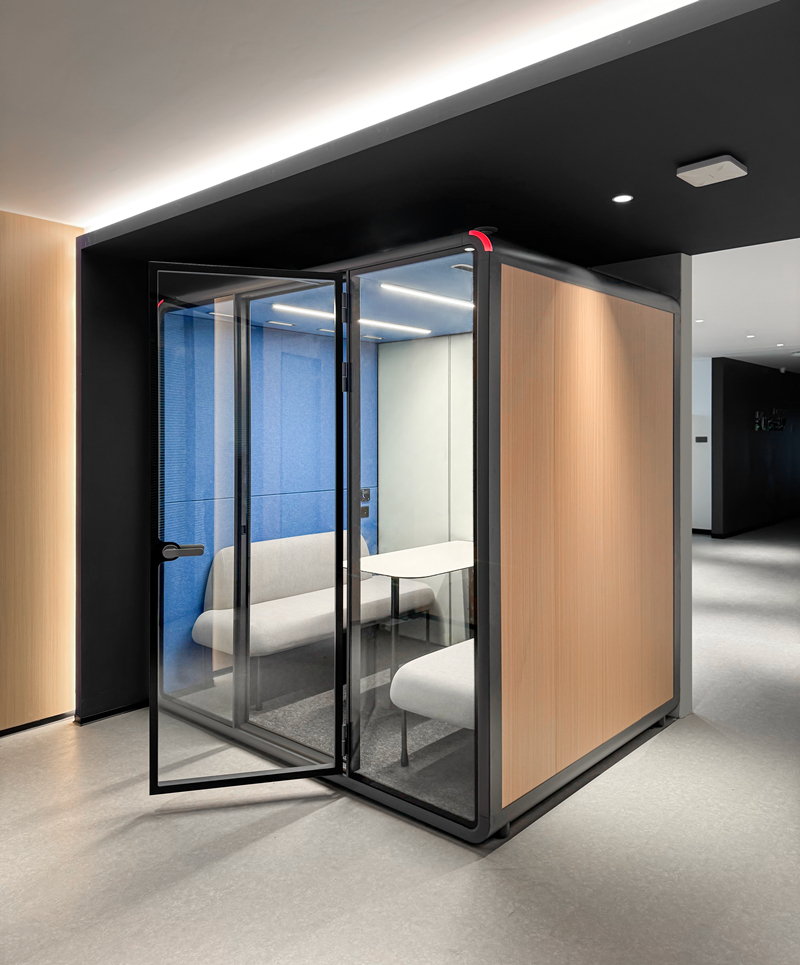
Soundproofing is the “passing line” for an office pod, but ventilation is the “comfort line” and “efficiency line”—it determines whether a person can stay inside comfortably for 30 minutes, an hour, or even longer, rather than feeling compelled to step out for fresh air every quarter of an hour.
When an office pod learns to ventilate automatically when unoccupied and quietly maintain airflow when occupied, it truly transforms from a “soundproof box” into a workspace that can be used continuously.
Interested?
Talk to us!
Contact our sales experts to know more about our product get a quote or book a visit. We are happy to help!
Contact Now !